How AI Chatbots Help Roofing Companies Capture More Leads 24/7
What happens when a homeowner visits your roofing website at 9:30 at night?
They may have a leaking roof.
They may have just experienced a storm.
They may be comparing roofing companies.
Or they may simply have a question before they're ready to call.
But if your business is closed, that potential customer may leave your website and contact someone else.
That's where an AI chatbot for roofing companies can make a difference.
An AI chatbot can help answer common questions, engage website visitors, collect lead information, and help move potential customers toward the next step—even when your team isn't available.
It doesn't replace your roofing team.
It helps your team respond faster and capture opportunities that might otherwise disappear.
Here's how.
Why AI Chatbots Matter for Roofing Companies
Roofing leads can come from many different places.
Someone might find your company through:
Google Search
Google Maps
Social media
A referral
A blog post
A paid advertisement
A local directory
An email campaign
Eventually, many of those prospects end up on your website.
And that's where the next decision happens.
Do they contact you, or do they leave?
A potential customer may have a simple question:
“Do you repair storm damage?”
“Do you serve my area?”
“Can I schedule a roof inspection?”
“Do you offer emergency roof repair?”
If they can't get an answer quickly, they may move on.
An AI chatbot gives your website another way to engage those visitors immediately.
What Is an AI Chatbot for a Roofing Company?
An AI chatbot is a conversational tool that can interact with website visitors and provide automated responses based on how it has been configured and trained.
For a roofing company, an AI chatbot can help with tasks such as:
Answering common questions
Explaining services
Identifying what a visitor needs
Collecting contact information
Asking qualifying questions
Helping schedule appointments
Directing visitors to the right page
Capturing leads outside business hours
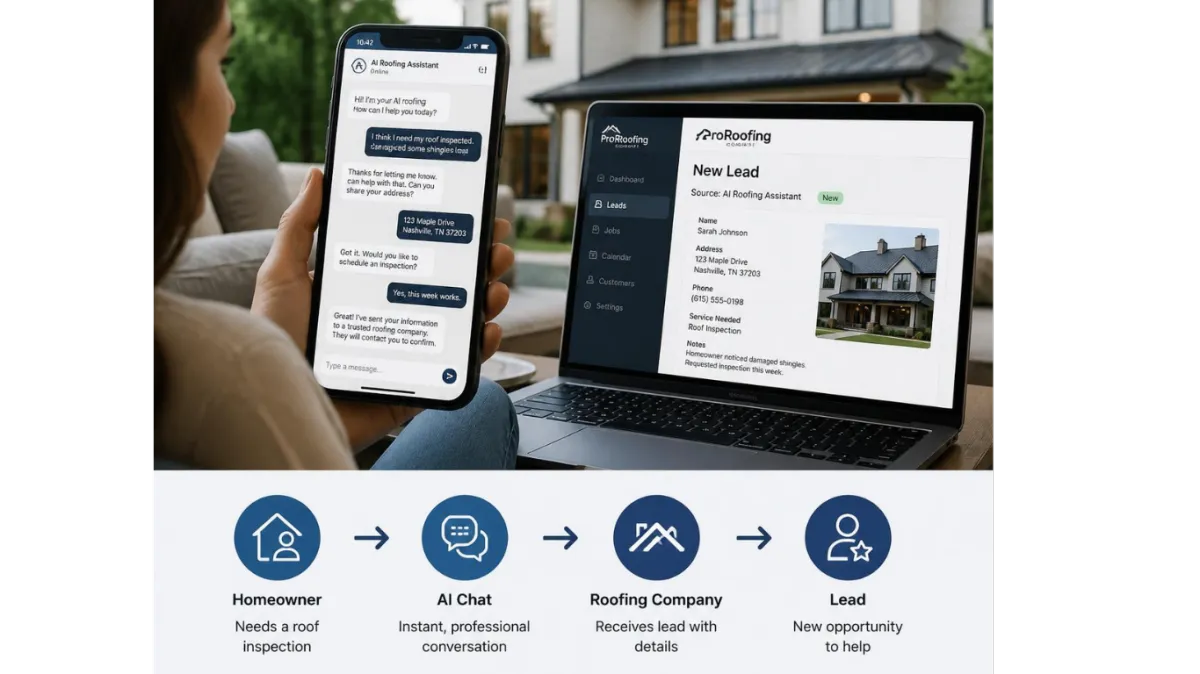
Instead of forcing every visitor to fill out a traditional contact form, a chatbot can create a more conversational experience.
For example:
Homeowner:
“My roof is leaking after the storm. Do you service this area?”
AI Chatbot:
“Yes, we provide roof repair services in this area. I can help you request an inspection. What is the best name and phone number for our team to contact you?”
The conversation can then move toward the appropriate next step.
The important part is that the chatbot should be designed around your actual business—not generic answers.
How AI Chatbots Can Help Roofing Companies Generate More Leads
1. Respond to Website Visitors 24/7
Your roofing company may not have someone available to answer questions every hour of the day.
That's normal.
But your website is available around the clock.
An AI chatbot can help bridge that gap.
A homeowner visiting your website after hours can still interact with your business and potentially provide information for follow-up.
This is especially useful for roofing companies because roofing problems don't always happen during business hours.
A storm doesn't care whether your office is open.
A roof leak doesn't wait until Monday morning.
A potential customer may search for help late at night, early in the morning, or over the weekend.
Having a way to engage that visitor immediately can help prevent the lead from disappearing.
2. Answer Common Roofing Questions Instantly
Your sales team probably hears the same questions repeatedly.
For example:
Do you repair roofs?
Do you replace roofs?
Do you handle storm damage?
What areas do you serve?
Do you offer roof inspections?
How can I request an estimate?
How quickly can someone contact me?
An AI chatbot can be configured to answer common questions consistently.
This can reduce friction for website visitors.
Instead of searching through multiple pages to find an answer, the visitor can ask directly.
The experience becomes more conversational.
And when a potential customer gets the information they need quickly, they're more likely to continue the conversation.
3. Capture Leads Before They Leave Your Website
One of the biggest problems with traditional websites is that you don't always know why someone left.
They may have been interested.
They may have been comparing companies.
They may have intended to contact you later.
But once they leave, you may never get another opportunity.
A chatbot can create an additional opportunity to capture information.
For example, it might ask:
“Would you like to schedule a roof inspection?”
If the visitor says yes, the chatbot can collect information such as:
Name
Phone number
Email address
Property location
Type of roofing issue
Preferred appointment time
The exact information collected should depend on your business and how the chatbot is configured.
The goal is simple:
Turn anonymous website traffic into an identifiable lead when the visitor is willing to engage.
4. Qualify Roofing Leads
Not every lead is the same.
One homeowner may need an emergency roof repair.
Another may be researching a roof replacement six months from now.
Another may be looking for commercial roofing.
Your sales team needs to understand the difference.
An AI chatbot can ask qualifying questions before the lead reaches your team.
For example:
What type of roofing service do you need?
Is there active damage?
What city are you located in?
Is this a residential or commercial property?
When are you looking to have the work completed?
These questions can provide your team with useful context.
Instead of receiving:
“Please contact me.”
your team may receive:
Roof replacement lead — residential property — Dallas — wants an inspection this week.
That's a much better starting point for a sales conversation.
5. Help Homeowners Find the Right Service
Roofing companies often offer multiple services.
A homeowner may not know exactly what they need.
They might say:
“I have water coming through my ceiling.”
They may not know whether they need a roof repair, inspection, or replacement.
A properly configured chatbot can ask additional questions and guide the visitor toward the appropriate next step.
For example:
“When did you first notice the leak?”
“Was there a recent storm?”
“Is the leak currently active?”
“Would you like to request an inspection?”
This doesn't mean the AI should diagnose the roof.
That's not its job.
Its job is to help the customer navigate the next step.
6. Make Appointment Scheduling Easier
Every additional step between a potential customer and an appointment creates friction.
If someone wants an inspection, don't make them search for a phone number, call during business hours, wait for a response, and then coordinate a time if there is a simpler option available.
A properly integrated chatbot can help guide customers toward appointment scheduling.
Depending on the system, the visitor may be able to:
Request an appointment
Choose an available time
Provide contact details
Describe the issue
Receive confirmation
That can create a smoother experience for both the homeowner and the roofing company.
7. Connect AI With Your Lead Follow-Up System
Capturing a lead is only the beginning.
What happens afterward matters just as much.
Suppose a homeowner interacts with your chatbot and provides their information.
That lead should ideally enter the appropriate process inside your CRM or marketing system.
From there, your business may be able to:
Notify the sales team
Create a new contact
Assign the lead
Trigger an appropriate follow-up
Send appointment information
Track the conversation
Record the service requested
This creates a connected system.
Instead of having an AI chatbot operating separately from your marketing, it becomes part of the larger lead-generation process.
Visitor → Conversation → Lead → Follow-Up → Appointment → Customer
That's where the real value comes from.
8. Give Your Sales Team Better Information
Imagine your salesperson receives two leads.
Lead A
John Smith
Please call me.
Lead B
Sarah Jones
Residential property
Roof leak after recent storm
Located in service area
Wants an inspection
Available tomorrow afternoon
Which conversation would be easier to start?
The second one.
A chatbot can collect useful information before a salesperson gets involved.
That means your team can spend less time asking basic qualifying questions and more time having meaningful conversations.
The objective isn't to replace your salespeople.
It's to give them better opportunities to work with.
9. Improve the Customer Experience
People don't want to feel like they're filling out paperwork just to ask a simple question.
A conversational interface can feel more natural.
Instead of:
Name:
Email:
Phone:
Message:
you might have:
Hi! What can we help you with today?
The visitor responds.
The chatbot asks the next relevant question.
The conversation continues.
This can make the process feel less like a form and more like an interaction.
For roofing companies, that can be especially useful when homeowners are stressed about a potential roof problem and simply want to know what to do next.
10. Use AI Without Losing the Human Element
This is one of the most important points.
AI should not make your roofing company feel less human.
It should help your team become more responsive.
A chatbot can handle repetitive questions and initial lead capture.
Your team should handle situations that require professional judgment, detailed estimates, inspections, negotiations, and actual roofing work.
Think of AI as the first layer of engagement, not the entire customer experience.
The best system knows when to keep the conversation automated and when to move the customer to a real person.
What Should a Roofing AI Chatbot Be Able to Do?
A useful roofing chatbot should be built around the actual customer journey.
Depending on the business, it may be able to:
Answer common roofing questions
Explain available services
Identify the visitor's location
Ask qualifying questions
Capture contact information
Help request an inspection
Assist with appointment scheduling
Direct visitors to relevant website pages
Provide basic business information
Alert the appropriate team member
Connect with CRM and follow-up systems
But don't try to make your chatbot answer everything.
A focused chatbot is often more useful than one overloaded with information.
Start with the questions your customers ask most often.
Then build from there.
Common AI Chatbot Mistakes Roofing Companies Make
AI can be powerful, but simply adding a chatbot to your website doesn't guarantee more leads.
Making the Chatbot Too Generic
A generic chatbot that knows nothing about your services, locations, or processes isn't very useful.
Train and configure it around your actual business.
Trying to Replace Your Team
AI should support your team, not pretend to be a roofing professional.
Know when the conversation needs to be handed off to a human.
Asking Too Many Questions
Don't make a homeowner answer 15 questions before they can contact you.
Ask what you actually need.
Giving Poor or Inaccurate Information
Incorrect information can damage trust.
Your chatbot should be based on accurate business information and should have clear limits around what it can and cannot answer.
Forgetting About Follow-Up
Capturing a name and phone number isn't enough.
The lead needs to enter a process where someone actually follows up.
Making the Chatbot Difficult to Use
If visitors can't understand what to do, they won't use it.
Keep the conversation simple.
How Long Does It Take to Set Up an AI Chatbot for a Roofing Company?
The timeline depends on the chatbot platform, the level of customization, the information it needs to work with, and whether it needs to connect with your CRM, calendar, or other systems.
A simple chatbot can be relatively quick to configure.
A more advanced system may require:
Custom conversation flows
Business knowledge
Lead qualification
CRM integration
Appointment scheduling
Human handoff
Follow-up automation
Testing and optimization
The important part isn't simply getting a chatbot live.
It's making sure the chatbot actually supports the customer journey.
Final Thoughts
Roofing companies spend a lot of time and money trying to generate website traffic.
SEO. Google Maps. Paid advertising. Social media. Referrals. Content.
But getting someone to your website is only half the battle.
The next question is:
What happens when they arrive?
If nobody is available to answer their question, help them find the right service, or guide them toward the next step, that visitor may disappear.
An AI chatbot can help fill that gap.
It can engage visitors 24/7.
Answer common questions.
Capture lead information.
Qualify prospects.
Help with scheduling.
And connect those opportunities with the systems your team already uses.
But the technology itself isn't the strategy.
The strategy is building a better path from:
Visitor → Conversation → Lead → Follow-Up → Appointment → Customer
At Your Business Nation, we help roofing and home-service businesses connect AI, SEO, lead generation, automation, and conversion systems so their marketing works beyond business hours.
Because generating more website traffic is great.
Turning more of that traffic into real roofing opportunities is better.
Get Found. Get Calls. Get Clients.